

Survive the Inflationary Storm By Graham Summers, MBA | Chief Market Strategist
Not long ago, the Fed was promising rate cuts.
Recently it raised rates instead. The vote was 12 to 0.
That is a stunning reversal, and it didn’t happen in a vacuum. Wholesale prices are rising at 5.4% a year. Gasoline is up 27%. The U.S. just crossed $40 trillion in debt. And the yield on the 30-Year Treasury just hit its highest level in nearly 20 years.
These are not separate stories. They are one story, and it starts with the single most important chart in the world.
The defining issue of the last 45 years has been the secular bull market in bonds. From 1980 until 2022, the yield on U.S. debt (called Treasuries) was in a downtrend. In the very simplest of terms, this meant that debt became ever cheaper to service. As a result, every entity in the U.S., whether it be corporations, municipalities, households, or the U.S. itself as a sovereign nation, went on a debt binge.
All of that debt matters, but the SYSTEMIC issue pertains to U.S. sovereign debt.
It took the U.S. over 215 years to hit $10 trillion in debt. It added its second $10 trillion in nine years. It added its third $10 trillion in less than five years. And on August 18, 2026, it crossed $40 trillion, adding the fourth $10 trillion in roughly four and a half years.
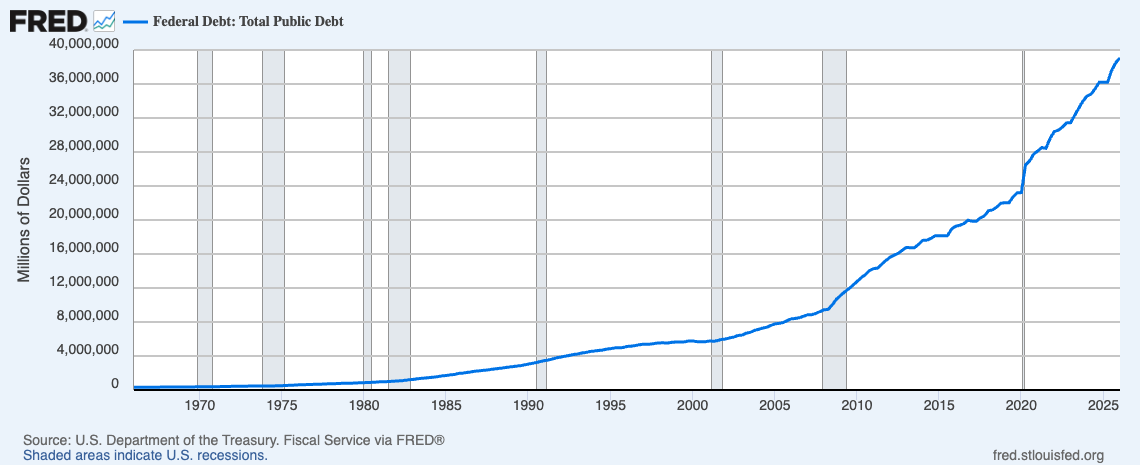
The U.S. now spends roughly $1.1 trillion a year on interest alone. That is more than it spends on national defense.
To be clear, the U.S. has had a debt problem for years. That’s nothing new. What IS new is that the bull market in bonds, the macro setup that allowed the U.S. to issue all this debt cheaply, is OVER.
Below is THE most important chart in the world. It’s the yield on the 30-Year U.S. Treasury. From 2022 until mid-2026, that yield traded in a range (purple rectangle in the chart below). This is called a consolidation period, and it’s 100% to be expected after a 40-year trend ends. No asset goes straight up or down.
That consolidation is about to end.
In September 2026, the 30-Year yield hit 5.37%, its highest level in nearly two decades. Twelve months earlier it was 4.75%. The 10-Year yield is back around 5% for the first time since 2023.
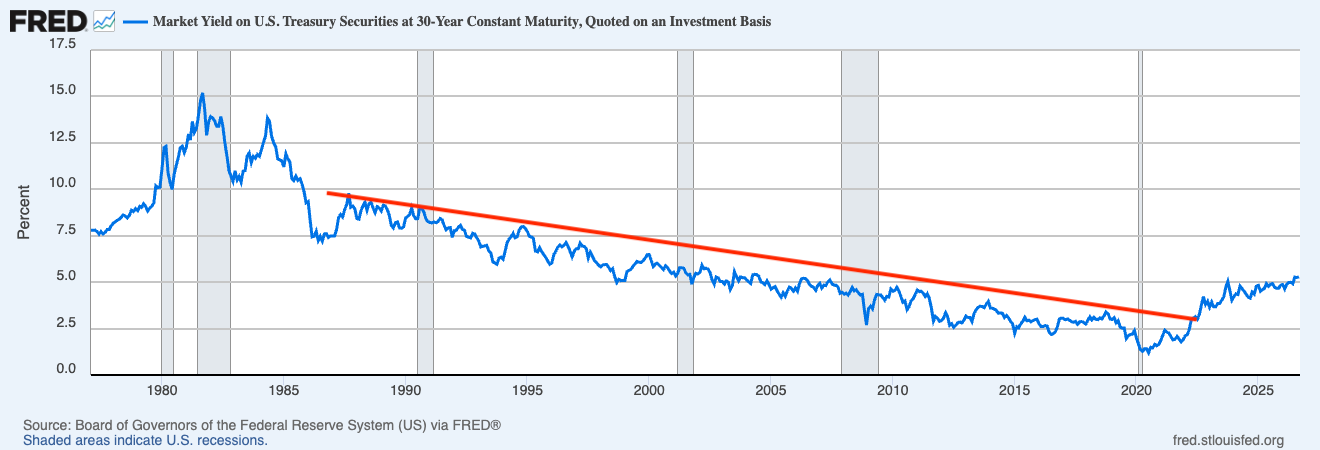
Put another way, for the first time in 45 years it is costing the U.S. MORE to issue new debt and to roll over old debt, and the bond market has now confirmed the trend.
This is a major signal, and investors should treat it as one. The era of ever cheaper money is behind us. Portfolios built for falling rates and low inflation need to be rebuilt around assets that benefit from the opposite.
So what pushed bonds out of their range?
A resurgence in inflation.
Inflation Is Back on the Rise
Consumer prices (CPI) rose 3.4% year over year in August 2026. That is well above the Fed’s 2% target. But CPI is a lagging measure. It tells you what already happened. The pipeline tells you what’s coming.
Producer prices (PPI), meaning what businesses pay before any of it reaches the consumer, are up 5.4% over the last 12 months. One month earlier that number was 4.7%. Go further up the pipeline and it gets hotter. Prices for stage 1 intermediate demand, the raw inputs that eventually become finished goods, are up 11.3% over the last year. Diesel fuel jumped 24.1% in August alone, and truck freight rates rose 2% in a single month.
Just about everything you buy arrives on a truck.
The source is no mystery. The conflict in the Middle East pushed oil above $100 a barrel, and disruptions to Saudi Arabia’s East-West pipeline kept it there. Energy prices are up 16.3% from a year ago. Gasoline is up 27.4%.
I want to be precise about where we are. This inflation has NOT gone broad yet. Strip out food and energy and core CPI is running at 2.4%, its lowest reading since 2021. Food prices, which Fed researchers have found to be one of the best predictors of future inflation, are up a modest 2.7%. Those are the two numbers I’m watching most closely. Energy shocks that last long enough work their way into everything else through freight, fertilizer and packaging, and the producer price data says that process has started. Core producer prices are already running at 4.7%.
The Fed sees it too, which is why it is raising rates again for the first time since 2023. Officials have signaled that more hikes are likely, and the Fed’s own forecast now has inflation ending 2026 at 3.7%.
Put simply, we have $40 trillion in debt, long-term yields at multi-decade highs, energy-driven inflation working its way through the pipeline, and a Fed that is tightening again. That is a very different world from the one most portfolios were built for.
With that in mind, the remainder of this report details FIVE investments to profit from the inflationary storm.
The first three are core positions. They are large, liquid, and built to be held. The final two are speculative in nature, and their position sizes should be much smaller.
Put another way, DO NOT put a lot of capital to work in the two speculative investments. They are EXTREMELY volatile and carry a far greater degree of risk than the first three.
OK, with that out of the way, let’s get started.
Investment #1: The VanEck Gold Miners ETF (GDX)
Gold is the oldest inflation hedge there is, and gold miners are the leveraged way to own it.
GDX is the largest and most liquid gold mining fund in the world. It holds the biggest, most established names in the business, including Newmont, Agnico Eagle and Barrick. These companies are already sitting on massive reserves, and when gold prices rise, their profits rise much faster.
Here’s why. A miner’s costs are relatively fixed. Most large producers pull gold out of the ground for well under $2,000 an ounce all-in. With gold around $4,400 an ounce, that’s a margin of more than $2,000 on every ounce sold, and every additional $100 in the gold price flows almost directly to the bottom line.
Gold hit a record of roughly $5,600 in January and has since pulled back about 20% as the Fed turned hawkish. That is the main risk here. If the Fed keeps hiking, gold can stay under pressure in the near term, and the miners will feel it. But with $40 trillion in debt and interest costs larger than the defense budget, I believe the long-term case for hard money is as strong as it has ever been. The pullback is offering a far better entry than investors had in January.
Investment #2: Cheniere Energy (LNG)
The inflation we’re dealing with today is energy inflation, and energy has become a weapon. Cheniere is how you own the solution.
Cheniere is the largest exporter of liquefied natural gas (LNG) in the United States. It owns the Sabine Pass terminal in Louisiana and the Corpus Christi terminal in Texas. When a conflict threatens the Strait of Hormuz or a Saudi pipeline, America’s allies in Europe and Asia need gas that doesn’t pass through a chokepoint. A great deal of it comes from Cheniere. Even Qatar, one of the world’s largest gas exporters, is reportedly in talks to buy LNG from U.S. suppliers.
It’s important to understand what you own here. Roughly 90% of Cheniere’s volumes are sold under long-term contracts, many of them 20 years in length, that lock in a fixed spread between what the company pays for gas and what it charges customers. That makes Cheniere more like a toll road than a bet on natural gas prices. You will not get the explosive upside of an oil producer during a price spike. What you get is decades of locked-in cash flow from an asset the free world cannot do without.
The company is also still growing. It just completed its Stage 3 expansion at Corpus Christi and shipped its 5,000th cargo. Shares trade around $270, roughly 20 times earnings, and are up about 17% over the last year. One note: Cheniere’s reported earnings swing sharply from quarter to quarter because of how its long-term contracts are accounted for. Focus on the cash flow, not the headline earnings number.
Investment #3: The Sprott Critical Materials ETF (SETM)
You cannot build a missile, a nuclear reactor, a data center or a power grid without copper, uranium, lithium, silver and rare earths. Washington has figured this out. The U.S. government is now taking direct equity stakes in mining companies and fast-tracking permits for projects it considers vital to national security.
SETM is the simplest way to own the entire theme. The fund holds 156 companies across the full range of critical materials. By sector it is roughly 28% copper, 25% uranium, 17% lithium, 17% silver and 10% rare earths. Its largest positions include Freeport-McMoRan, Cameco, Lynas Rare Earths and MP Materials. Importantly, by my count only a few percent of the fund sits in Chinese producers. If you’re investing in the race to break China’s grip on these supply chains, you shouldn’t be funding the other side.
Why does this belong in an inflation report? Because these are hard assets with constrained supply, new mines take a decade or more to build, and demand is increasingly backed by government mandate instead of the consumer. That holds up whether inflation runs at 3% or 6%.
A word of caution. This fund moves. It fell 15% in June and rose 21% in August. It returned 60% in the 12 months through August, so you are not early, but you ARE buying a theme with years left to run. It’s also a smaller fund, so use limit orders when you buy.
Investment #4: Capitan Silver (CAPTF)
This is the first of our two speculative plays. Size it accordingly.
Capitan Silver is an explorer advancing the Cruz de Plata silver-gold project in Durango, Mexico, in the heart of the most productive silver belt on earth. Silver has a dual role as both a monetary metal and an industrial one, which is why it tends to outperform gold during inflationary runs. Large, high-grade primary silver deposits are exceptionally rare. Capitan believes it has found one.
The drill results back that up. In 2026 the company has reported intercepts including 1,541 grams per tonne silver equivalent over 1.5 metres within a wider zone of 18.3 metres grading 202 g/t, and 1,071 g/t over 2.0 metres within 15.8 metres grading 250 g/t. In September 2026, it reported 35 more holes, with high-grade mineralization at every priority target area. The property also hosts the Capitan Hill oxide gold deposit, with an inferred resource of 525,000 ounces of gold.
Capitan is now running a 60,000-metre, multi-rig drill program, four times the size of last year’s, backed by C$29 million raised from institutional investors. It was named to the 2026 TSX Venture 50. The next major catalyst is a maiden silver resource.
The risks are real. Capitan has no revenue and no silver resource yet. It will need to raise more money, which means dilution. It operates in Mexico, and its U.S. shares trade over the counter, so volume can be thin. Use limit orders, keep the position small, and expect big swings in both directions.
Investment #5: Trilogy Metals (TMQ)
This is our second speculative play, and it comes with an unusual partner: the Pentagon.
On September 11, 2026, the U.S. Department of War closed a $35.6 million investment that made the federal government a roughly 10% shareholder of Trilogy Metals. You read that correctly. Washington is now on the shareholder register.
Trilogy owns 50% of the Upper Kobuk Mineral Projects in Alaska’s Ambler Mining District, one of the richest undeveloped copper districts in the world. Its partner is South32, a major global miner. The district hosts the high-grade Arctic deposit (copper, zinc, lead, gold and silver) and the Bornite copper-cobalt deposit. The problem has always been access. The district needs a 211-mile industrial road, and the previous administration blocked it.
That has changed. The President has directed federal agencies to advance the Ambler Road, the Department of War has committed to help arrange its financing, and in May 2026 the Arctic project was accepted into the federal FAST-41 program, which streamlines permitting for priority infrastructure.
Here’s what makes the setup interesting. The government bought in at $2.17 per unit. TMQ spiked as high as $11.29 when the deal was first announced, and it has since fallen all the way back to around $3.20. The hype has washed out, the deal has closed, and you can buy within striking distance of Washington’s price. The stock still made the 2026 TSX30 with a 570% gain over three years.
Now the risks. Trilogy has no revenue and is years from production. The road faces environmental and indigenous opposition, and a future administration could reverse course again. The government also received warrants that will dilute shareholders. This stock can fall 15% in a day, and it has. Keep the position small.
And there you have it: FIVE investments for the inflationary storm. Three core positions in gold, energy security and critical materials, and two speculative plays with serious upside if the thesis plays out. If the secular bear market in bonds continues, I expect hard assets like these to be among the biggest beneficiaries.
This concludes this Special Investment Report. Thank you for reading!
And there you have it: FIVE investments that should perform exceptionally well as the next inflationary storm arrives. And if the U.S. enters a secular bear market in bonds, the upside here could be massive.
This concludes this Special Investment Report. Thank you for reading!